Explore the intersection between traditional stock markets and cryptocurrencies with our dedicated stock market resources. Discover how digital assets are influencing financial markets and how to integrate cryptos into your investment portfolio. Our articles offer:
Guides on investing in the stock market and crypto
Tutorials to diversify your portfolio
Market trend analysis
Opinions on blockchain-related stocks
The latest economic and financial news
Learn how to:
Understand the correlations between the stock market and cryptos
Identify innovative investment opportunities
Manage risks associated with volatile markets
Whether you are a stock market or crypto investor, our resources will help you make informed decisions to maximize your returns.
Polymarket has entered a new phase of expansion as its US relaunch begins after years away from the domestic market. According to recent reports, the platform is moving quickly to bring waitlisted users into its updated app, starting with sports event contracts. Regulatory clearance arrived earlier this year, opening the door for a compliant return.
Two ETFs backed by XRP have just been listed on the NYSE, a first meant to propel Ripple to the rank of institutionalized crypto assets. However, the market sends an opposite signal. The crypto collapses below 2 dollars, down 35% for the quarter. Far from a bullish turning point, this regulatory advance reveals a persistent disinterest. The ETF effect, expected as a driver, seems to have had no tangible echo.
While the SEC digests its shutdown, Grayscale speeds towards Wall Street. An IPO? Yes, but under tight control. Crypto enters the stock market... and not democracy.
While the crypto industry regains market confidence thanks to clearer regulation and growing interest from institutional investors, Ripple opts for an unexpected direction. Despite a legal victory against the SEC and a year of exceptional growth, the Californian company forgoes any public offering. A choice that contrasts with the ambitions of other industry players and raises questions about the company’s long-term strategy.
Nasdaq has formally reprimanded TON Strategy for violating listing rules tied to its $272.7 million Toncoin purchase and related PIPE financing. The company, formerly known as Verb Technology Company, failed to secure shareholder approval before issuing stock to fund the deal, according to a recent SEC filing.
Nvidia has just made its name in history by becoming the first company to exceed 5,000 billion dollars in market capitalization, ahead of Apple, Microsoft, and Amazon. This record is not just a financial feat. It reflects a changing era, where artificial intelligence, supercomputers, and cloud infrastructure are reshaping the balance of power in global tech.
Gita Gopinath, former IMF Deputy Director, warns of a potential financial explosion. Driven by the euphoria around artificial intelligence, the current rally in US markets could, according to her, trigger an unprecedentedly violent global correction. At stake, up to $35 trillion in losses on global assets.
Prediction markets have received a major vote of confidence after Intercontinental Exchange (ICE)—the operator of the New York Stock Exchange—announced a $2 billion strategic investment in Polymarket. The deal values the platform at roughly $8 billion, marking a stunning turnaround for a company that faced regulatory fire just three years ago.
The European stock market has just closed an exceptional week. The STOXX 600 rises by 2.8% and continues to break records. Health, banks, and mining lead the way, driven by palpable optimism.
The US markets celebrated Monday the confirmation of a preliminary agreement between Washington and Beijing regarding the future of TikTok. Oracle, the favorite to acquire the Chinese platform, jumped more than 3% while the S&P 500 crossed the symbolic threshold of 6600 points for the first time.
Sharplink Gaming Inc. has kicked off a $1.5 billion share buyback plan as its stock trades below the company’s net asset value (NAV). The buyback signals a strategic effort to enhance shareholder value while market sentiment currently undervalues its Ether treasury holdings. The company, the second-largest Ether treasury firm, is leveraging this move to strengthen investor confidence and optimize capital allocation.
In just three days, the American stock market witnessed a rare spectacle: eight of the largest tech companies saw their capitalization jump by 420 billion dollars. A lightning movement that repositions Google at the center of the game and confirms how regulatory decisions and advances in artificial intelligence now influence Wall Street.
Unknown to the general public but omnipresent behind the scenes of power, Palantir works with governments and multinationals by exploiting data. Valued at over 400 billion dollars after a 2000% increase since 2023, it represents either the investment opportunity of a generation or the next speculative bubble ready to burst.
American indices continued their rise, boosted by July inflation below forecasts. This macroeconomic signal propelled expectations of a Fed rate cut as early as September, now almost certain in investors' eyes. Driven by this momentum, optimism also spreads to the crypto market and Asian tech giants, drawing a global movement where macroeconomics, traditional finance, and DeFi advance together.
Warning signs are everywhere. Between the explosion of inequalities and record debt, the global financial system is dangerously shaky. Faced with 37 trillion dollars of debt in the United States alone, one question arises: are we witnessing the end of capitalism as we know it?
Markets waver, cryptos drop. Under the combined effect of a resurgence of trade tensions and mixed economic indicators, technology stocks suffered a sharp setback. In their wake, crypto stocks like Coinbase, Riot Platforms, and CleanSpark fell heavily, amplifying losses recorded on a bitcoin that fell below 115,000 dollars. This new volatility episode reveals the extreme sensitivity of cryptos to the global economic agenda and monetary policy expectations.
Polymarket, the crypto platform specializing in predictive markets, is making its big return to the United States. To achieve this, it is betting on the acquisition of QCX, an exchange regulated by the CFTC. An ambitious move that could redefine the future of prediction on the blockchain.
The crypto market has just crossed a symbolic threshold: $3.8 trillion in capitalization. This is more than Amazon's valuation, almost as much as the GDP of the United Kingdom. Far from a simple bullish cycle, this surge propels cryptocurrencies to the status of systemic players. A turning point that reshuffles the cards: this market is no longer peripheral; it now competes with major economic powers. While financial capitals observe, the cryptosphere sets its own pace and redraws the contours of the global economy.
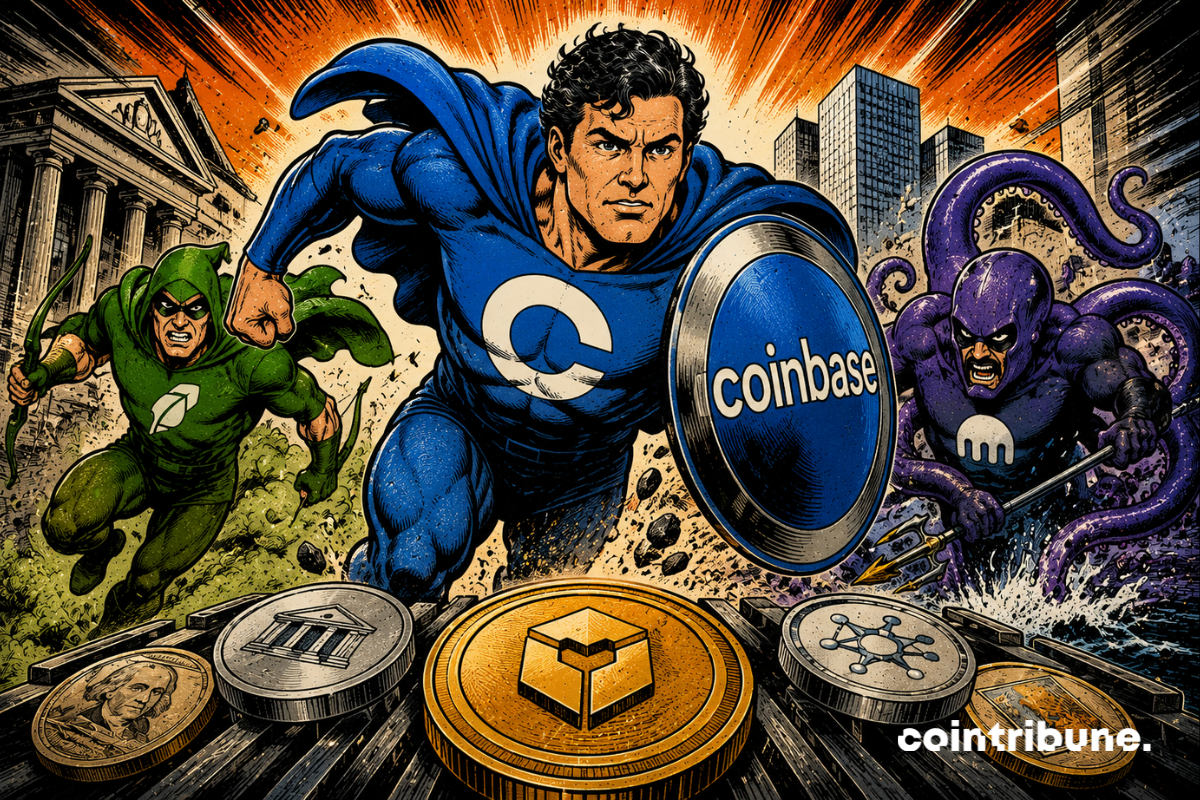
When a crypto company enters the S&P 500 and then joins TIME's list of the 100 most influential companies, it is no longer just recognition: it is a signal of a shift in era. By 2025, Coinbase is no longer just an exchange; it becomes a symbol of the normalization of Web3 within the circles of global economic power. Its rise marks a clear break between the utopian promises of the sector and its integration into traditional structures of influence.
Wall Street continues to set records, and crypto holds its breath. As the Nasdaq and S&P 500 reach historical highs, the prospect of monetary easing by the Fed revives bullish scenarios. In this climate of optimism, a question arises: is Bitcoin ready to cross a new symbolic threshold? With favorable macroeconomic signals and renewed institutional interest, the hypothesis of BTC exceeding $112,000 resurfaces, fueled by the dynamics of traditional markets.
"Driven by an unexpected easing in the Middle East and a resurgence of stock market optimism, the S&P 500 closed this Thursday at 6,141.02 points, nearing its all-time high. Increasing by 0.8%, the benchmark index marks a significant rebound since its low in April, despite ongoing uncertainties regarding trade tariffs and regional stability."
Despite a decline in profits, companies in the CAC 40 are increasingly attentive to their shareholders. In 2024, they maintain record payouts, contrary to traditional economic signals. In an environment marked by sluggish growth, rising inflation, and unstable markets, this strategy raises questions. Is it a sign of strength or a risky bet? While shareholder profitability remains a priority, the gap between distributed profits and actual performance raises doubts about the sustainability of this model.
The conflict between Israel and Iran raises fears of a major escalation, yet U.S. indices are flirting with their all-time highs. Following U.S. bombings in Iran, this situation could change very quickly, casting doubt on a sudden market collapse.
The stock market has its moods, but sometimes, it is mostly its fears. And this Friday, fear prevailed over everything else. An Israeli strike against Iran was enough to cause an immediate shock on global markets, reminding everyone that indices are never completely disconnected from the sound of bombs. In New York, the Dow Jones dropped more than 600 points right at the opening. A brutal collapse that owes nothing to chance, but everything to geopolitics. In this unstable equation, volatility has become the norm again, and the stock market a sounding board for the real world.
Circle's IPO made history on Wall Street with the largest two-day gain since 1980. However, behind this spectacular performance lies a troubling paradox: the issuer of USDC literally forfeited 3 billion dollars to institutional investors. How can this colossal financial sacrifice be explained?
In an environment marked by uncertainty and geopolitical tensions, the Chinese stock market demonstrates remarkable resilience. As trade discussions between the United States and China resume in London, the stock markets of Hong Kong and mainland China are witnessing a significant rebound, driven by the technology, pharmaceutical, and rare earth sectors. This dynamic could profoundly influence the financial balance in Asia in the coming months.
Yesterday, Paolo Ardoino, CEO of Tether, spoke directly on X (formerly Twitter) to respond to speculation about a potential IPO. Despite a theoretical valuation estimated at 515 billion dollars, he dismissed the rumors, stating that Tether has no intention of going public.
Gemini takes a strategic step with the filing of an IPO project with the SEC. In an industry where every initiative from a historical player can reshape the market, the platform founded by the Winklevoss brothers aligns itself with traditional finance without renouncing its crypto roots. Against a backdrop of regulatory relaxation and renewed enthusiasm for cryptocurrencies, this decision is not merely a tactical move, as it lays the groundwork for a new balance between decentralized innovation and traditional stock market infrastructures.