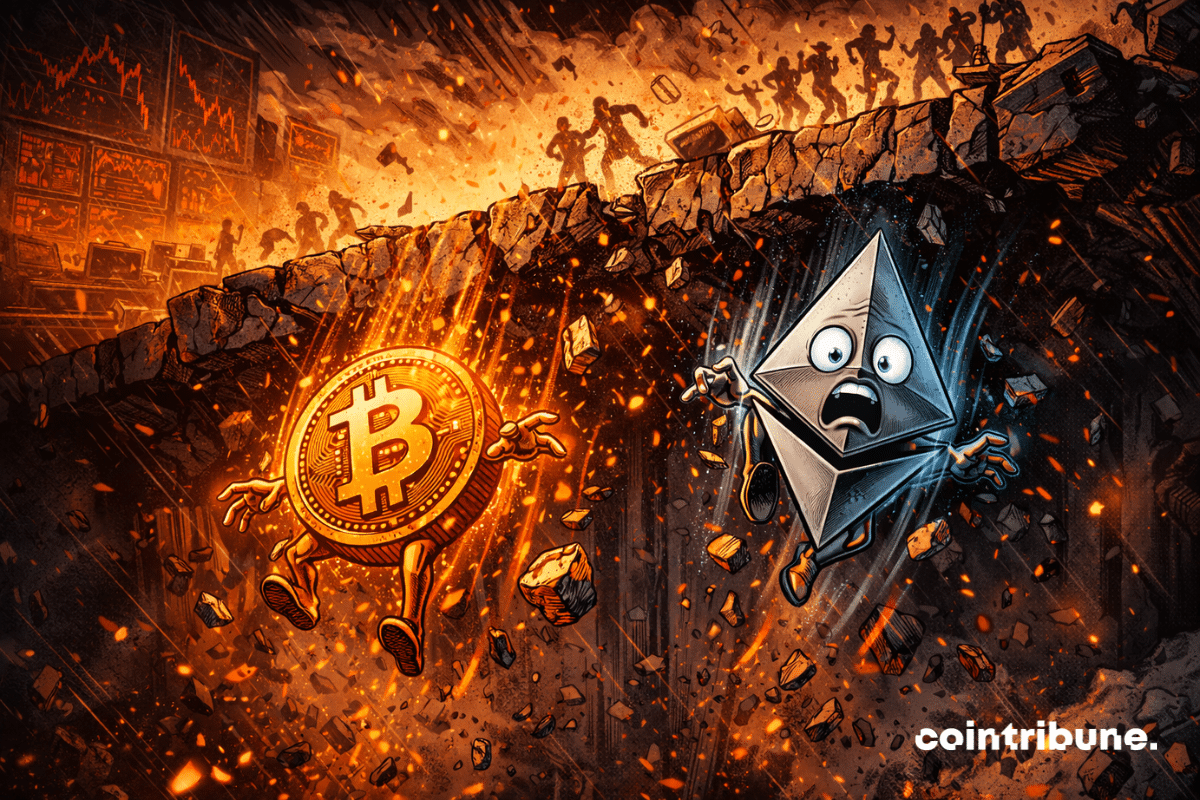
These companies thought they were riding the bitcoin wave, but they are drowning in their own debts. The crypto king is nosediving, and the kings of leverage are getting slapped.
Ether has entered an important phase as exchange balances drop to their lowest level in nearly ten years. Supply continues moving into staking and long-term holding, leaving fewer tokens available for trading. Market structure is tightening even as investor sentiment remains cautious. Recent network events and steady institutional demand are also adding to this overall market trend.
Bitcoin has just crossed $91,000, but the euphoria is not spreading to all market segments. Mining company stocks fell 1.8% over the week, while trading volumes dropped 25%. This decline reflects less a simple technical pause than a deeper malaise in a sector weakened by rising production costs.
BPCE, a heavyweight in the French banking sector, launches its crypto trading service this week through its mobile applications. A revolution: buying Bitcoin will become as easy as checking your balance.
While bitcoin is bogged down under the spotlight, fleeing ETFs and traders under Lexomil: the crypto star rediscovers the joys of the plunge, 2022 version, remixed 2025.
Financial commentator Peter Schiff is back in the news as tensions rise between him and President Donald Trump over the state of the U.S. economy. Schiff’s warnings about rising prices clash with Trump’s claims that affordability is improving across the country. At the same time, Schiff has also renewed his public dispute with Binance founder Changpeng Zhao (CZ), giving his comments even more visibility.
Bitcoin Cash has an early year that few observers anticipated. While most L1 blockchains struggle to stand, BCH moves forward confidently, as if the entire market has finally decided to reconsider its place in the crypto landscape. A sharp, almost disorienting rise that contrasts with the lethargy of other major networks.
Could bitcoin make a notable comeback by the end of the year? As markets scrutinize Federal Reserve decisions, the flagship crypto benefits from a more favorable macroeconomic environment. The improvement in global liquidity and the prospect of monetary easing fuel hopes for a rebound in December. Behind this emerging optimism, investors remain on alert: a single misstep by the Fed could question everything.
Below 90,000 dollars, bitcoin sends a strong signal. A key profitability indicator hits its lowest level in two years, marking a possible market reset. Behind an apparently stable price, on-chain data reveals a profound shift in investor behavior.
Pakistan has confirmed its intention to launch its first ever stablecoin. This initiative speaks volumes about the country's ambition. Indeed, Pakistan wants to catch up digitally, secure its financial flows and establish itself in an increasingly tokenised global economy. Behind this decision lies a much broader strategy involving central bank digital currency, Bitcoin mining and the widespread deployment of AI.
"He who does not move does not feel his chains." Rosa Luxembourg’s phrase resonates strangely in the digital age. Digital currency today reveals invisible chains that many still do not perceive. Cash quietly disappears, replaced by a recorded, analyzed, and continuously interpreted world. Every transaction becomes data, and every data a lever of control. Privacy is no longer a moral luxury, but a political fault line. Institutions defend transparency as a condition of stability. Freedom advocates see privacy as a fundamental guarantee. This tension reshapes our relationship to power, trust, and individual autonomy. The central question is no longer just about technology, but about what we accept to reveal in order to exist. This text explores the existential battle of monetary privacy: protecting human dignity when everything becomes traceable.
Cantor Fitzgerald shakes the markets by lowering its target for Strategy (MSTR) by 60%. However, the bank dismisses fears of forced liquidation and maintains its confidence in bitcoin. An analysis that unpacks the stakes behind this surprise decision and its impact on crypto investors. Is MSTR's future being decided now?
What if everyone was wrong about Strategy? While speculation is rife about a potential bitcoin sale by the company led by Michael Saylor, Bitwise's Chief Investment Officer, Matt Hougan, steps up to methodically dismantle this panic scenario.
Bitcoin ETFs just experienced their worst day in two weeks, with $194 million in outflows in 24 hours. Between institutional disengagement and macroeconomic fears, should we expect a black December? Comprehensive analysis and outlook for crypto investors.
Backed by its status as a benchmark in the crypto market, bitcoin faces a crucial question: can it reconnect with the euphoria of last January, when it broke $109,000 for the first time? Between macroeconomic uncertainties and structural advances, BTC's trajectory triggers as many expectations as doubts. Is the bull cycle already behind us or just on pause?
When a company named Strategy becomes the compass of bitcoin, even JPMorgan takes out its calculator. Bull run or crash? The answer lies between MSCI, reserves, and a few well-placed billions.
After weeks of volatility, Bitcoin is showing signs of settling, with analysts noting cautious optimism and the possibility of a year-end rally.
During Binance Blockchain Week, Peter Schiff was invited by Changpeng Zhao to authenticate a gold bar live. Unable to confirm its authenticity, the economist simply replied: "I don't know." A brief but revealing scene, which reignites the debate between physical gold and bitcoin, and raises questions about the verifiability of assets in a world increasingly oriented towards decentralization and blockchain transparency.
The European Union wants to entrust ESMA with a key role in crypto supervision. With MiCA, an ambitious reform is taking shape, balancing enhanced security and concerns about innovation. This extension of powers could change everything for investors and platforms. Essential details to know.
The sharp rejection of the $93,500 threshold this Thursday cooled the enthusiasm of a market seeking bullish confirmation. This level was expected as a symbolic pivot before a key Federal Reserve deadline. Far from a simple technical pullback, this retreat triggers doubts about BTC's ability to start a sustainable rally, in a climate where every economic figure weighs on monetary expectations.
While Bitcoin is leading a new rally, Solana sends a much more puzzling signal: capital is exiting ETFs but continues to flow on the blockchain. On one side, 21Shares sees its TSOL crypto ETF lose $42M. On the other, over $321M redeploy directly on-chain on Solana. An apparent contradiction that says a lot about the real state of the market.
As speculative frenzy once again takes hold of the cryptocurrency market, the SEC decides to put a firm brake on excesses. By targeting the most aggressive leveraged crypto ETFs, the regulator sends a clear signal: the era of "x5" products sold to the general public without genuine safeguards is reaching its limits. Between the desire to regulate innovation and the necessity to protect investors, a new red line is being drawn in the crypto ecosystem.
Crypto mergers and acquisitions reached $8.6 billion in 2025, with Coinbase, Ripple, and Kraken among the major firms expanding their operations.
Former SEC Chair Gary Gensler rehashed debate over digital assets in a Bloomberg interview, saying Bitcoin stands apart from the rest of the crypto market. He warned that most tokens still act as speculative bets with little support behind their valuations, setting a cautious tone for investors.
Larry Fink, CEO of BlackRock, acknowledged a change of stance on bitcoin. Long critical of cryptos, he now says he has revised his strategy. At the DealBook Summit organized by the New York Times, he mentioned a notable evolution in his perception of the asset. A symbolic shift, which also reflects the gradual adjustment of the institutional view on cryptos.
Bitcoin is changing dimension. For the first time since its creation, it is establishing itself as a pillar of institutional allocation. According to a joint analysis by Glassnode and Fanara Digital, $732 billion of new capital has been injected since the 2022 low, an absolute record surpassing all previous cycles combined. This massive flow does not reflect mere temporary euphoria but signals a structural market shift. Bitcoin is no longer merely speculative; it becomes a strategic asset in institutional portfolios.
Strategy, the Bitcoin giant, has suddenly slowed its purchases: only 130 BTC in December 2025, compared to 134,000 in 2024. A worrying turnaround or a brilliant tactic? After a last massive purchase of 8,178 BTC in November, the market wonders: should we fear a collapse or prepare for a historic rebound?
As Bitcoin passes through a new turbulence zone, Michael Saylor finds himself at the heart of a decisive showdown with MSCI. Threat of exclusion from indices, pressure from institutional investors, and massive exposure to the king asset: his bet on Bitcoin is more tested than ever.
Driven by the inflow of institutional capital, the crypto market seemed to stabilize. However, a wave of liquidations on derivative products highlights its fragility. According to Glassnode, these liquidations have nearly tripled, a consequence of excessive leverage now under strain.
While many eyes remain fixed on Bitcoin and Ether, Solana is currently playing a much subtler game. The SOL crypto still holds above the 120 dollar area, but this level is not just a technical support: it is supported by a real shift in liquidity and on-chain supply. However, trader-side demand remains surprisingly timid. And as long as this gap persists, Solana's structural advantage is not fully reflected in the price.