Ethereum returns a positive signal on derivatives despite pressured ETFs
While the crypto market remains hesitant, Ethereum sends an unexpected signal behind the scenes. Behind an apparent phase of stagnation, some indicators show an evolution in investor behavior. While institutional flows slow down, the derivatives market reveals a different dynamic. This discrepancy raises a central question: is the queen of altcoins preparing a subtle reversal?

In brief
- The Ethereum derivatives market shows a return of buying pressure after a long phase dominated by sellers.
- The Net Taker Volume returns to positive territory, a rarely seen signal over several years.
- Ethereum ETFs record continuous capital outflows, reflecting a decline in institutional interest.
- The divergence between derivatives and spot market creates an uncertain dynamic but opens the way for a possible reversal.
Ethereum derivatives confirm a market reversal
First, Ethereum on-chain data analysis reveals a progressive shift in the derivatives market. While selling pressure dominated for several months, buyers are now regaining the advantage. This change mainly relies on the evolution of the net taker volume, a key indicator to measure the dominance of buyers or sellers on Ethereum derivative products.
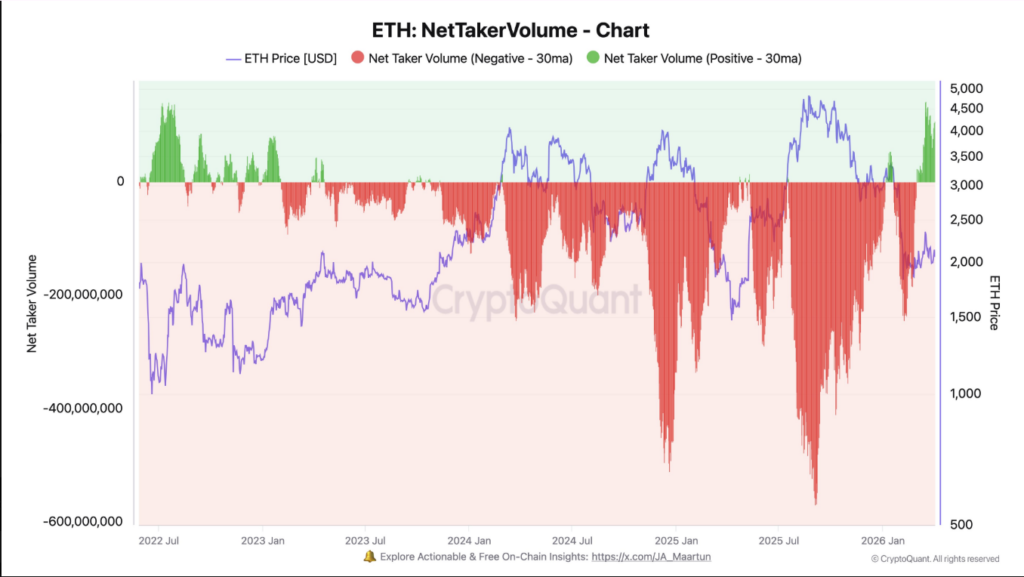
According to data shared by analyst Darkfost, the net buyer volume on Ethereum turns positive again, confirming a return of buying pressure on derivatives, a rare signal that draws attention after the bearish phase.
- The net taker volume exceeds a buyer surplus of $104 million.
- The Ethereum price has hovered around $2,058 for 1 month, with a 0.6% increase over 24 hours.
- Buying dominance appears for the first time in three years, marking a regime change in derivatives.
- The market begins a gradual transition towards a more constructive dynamic.
Thus, these signals reflect a progressive evolution where positions adjust without precise validation from the spot market.
ETFs under pressure : persistent capital outflows
At the same time, Ethereum ETFs continue to send an opposite signal. U.S.-based exchange-traded funds record capital outflows for the third consecutive week.
Last week, these products suffered more than $42 million in withdrawals. Moreover, a single day concentrated more than $71 million in outflows across all crypto products.
Thus, this trend reflects a decline in institutional investors’ appetite. It directly contrasts with the renewed activity observed in Ethereum derivatives. Additionally, this divergence between derivatives and the spot market creates uncertainty about the solidity of the current signal.
Positive signal but still fragile balance for Ethereum
Despite pressure from ETFs, the derivatives market shows signs of evolution. This return of buying pressure could help stabilize the price and form a floor.
Indeed, a lasting buyer dominance on derivatives may precede a broader market recovery. However, this scenario will strongly depend on investor behavior in the spot market.
Moreover, Ethereum is currently evolving in a phase of balance between positive signals and external pressures. On one side, derivatives indicate renewed interest. On the other, ETFs continue to weigh on overall sentiment.
Thus, if ETF flows reverse and support this dynamic, Ethereum could regain a more favorable structure. Conversely, a lack of confirmation would limit the impact of this signal. However, the coming weeks will remain decisive. Without support from the spot market, this recovery could remain limited in a context marked by the rise of staking on ETH.
Maximize your Cointribune experience with our "Read to Earn" program! For every article you read, earn points and access exclusive rewards. Sign up now and start earning benefits.

Journaliste et rédacteur web passionné par l’univers des cryptomonnaies et des technologies Web3. J’y traite les dernières tendances et actualités afin de proposer un contenu de haute qualité à un large public du secteur.
The views, thoughts, and opinions expressed in this article belong solely to the author, and should not be taken as investment advice. Do your own research before taking any investment decisions.