Bitcoin Under Fire as US Inflation Surges Past Expectations
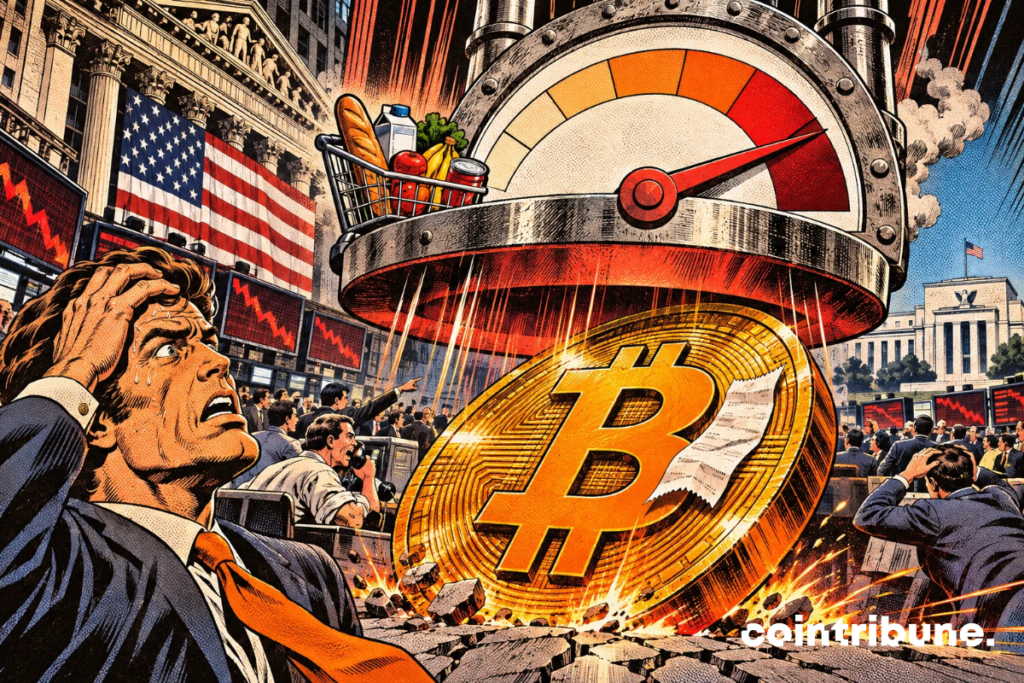
Bitcoin declined to around 73,600 dollars on November 10, 2026, following the release of higher-than-expected US inflation. The Consumer Price Index (CPI) rose by 0.4% in October, compared to the anticipated 0.3%. Core inflation also exceeds forecasts. Investors now anticipate another Fed rate hike in December, with the possibility of a larger tightening than expected.
In Brief
- US inflation reaches 0.4% in October, compared to 0.3% expected by economists.
- Bitcoin declines around 73,600 dollars after the CPI release.
- Markets anticipate a Fed rate hike in December, potentially 50 basis points.
Why Does US Inflation at 0.4% Worry Bitcoin?
The US Bureau of Labor Statistics (BLS) published its inflation figures on November 10. Consumer prices rose by 0.4% in October, after a 0.6% increase in September. Inflation thus slows over one month. The problem comes from the forecasts.
Economists expected a limited increase of 0.3%. The result exceeds their estimates by 0.1 percentage points. Bitcoin, already facing several unfavorable factors for November, thus faces new macroeconomic pressure.
Core inflation, which excludes food and energy prices, also reaches 0.3%. Forecasts had estimated 0.2%. This indicator particularly draws the attention of the US Federal Reserve. It better observes inflationary pressures that persist beyond fluctuations in energy products.
October’s result extends those of the two previous months. Core inflation had already increased by 0.3% in August and September. Housing prices also rose by 0.3%. They contribute more than 30% of the monthly increase of the general index.
Food prices rise by 0.5%, while energy prices increase by 0.7%. The latter had, however, jumped 5.2% in September. Another peculiarity of the report: the BLS does not publish an annual inflation rate for October. The interruption of federal activities in October 2025 prevented collecting the data necessary for that comparison. The last available annual measure for the general index remains September’s, at 3.7%.
How Did Bitcoin React to the CPI Release?
The market reaction was swift. Before the report was released at 8:30 AM New York time, bitcoin traded around 74,300 dollars. Investors were already watching US figures after several difficult sessions.
A few minutes after the announcement, BTC dropped to around 73,600 dollars, deepening previous losses. Other readings showed a temporary dip around 73,400 dollars before stabilizing in the upper part of the 73,000 dollar range.
Bitcoin was already trending downward before the CPI numbers. Thus, the announcement accentuated an existing movement rather than solely causing the entire correction. Market fragility is not new since Tuesday. In October, bitcoin lost 7.32%, ending three consecutive months of gains. After briefly surpassing 87,000 dollars earlier in the month, it finished October around 77,000 dollars.
The first part of November did not allow for a durable recovery of the lost levels. The 74,000 dollar mark now constitutes a price threshold watched by traders. A return above this zone could accompany stabilization but is not enough to confirm a bullish reversal.
Conversely, continued selling below the levels reached Tuesday would leave the market exposed to a new correction. The reaction does not concern only bitcoin. Futures contracts for major US indices also dropped after the report.
The Nasdaq 100 lost about 1.15% and the S&P 500 nearly 0.5% at the time of CoinDesk’s initial publication. Investors were then reducing exposure to several interest rate-sensitive assets.
Why Might the Fed Raise Rates in December?
The inflation report arrives at a critical time for US monetary policy. The Fed is set to hold its last meeting of the year on December 8 and 9, 2026. Before the CPI release, investors already anticipated another rate hike.
Tuesday’s figures reinforce these expectations. Christopher Waller, Federal Reserve governor, had indicated the day before that a rate increase might still be necessary in December, even with relatively moderate inflation.
He also mentioned the possibility of a 50 basis point increase if new data showed sufficiently high inflation. The 0.3% result for core inflation corresponds precisely to the level fueling this discussion.
Markets immediately adjusted their expectations. According to Reuters, investors briefly assigned about a 15% probability to a 50 basis point increase in December. A 25 basis point hike remained the dominant scenario.
The Fed, however, has announced no decision. The central bank also examines employment, financial conditions, and economic activity before changing rates. On November 6, US statistics reported 165,000 job creations in October, with an unemployment rate of 4.1%.
These data do not suggest an immediate labor market collapse. For monetary authorities, this resilience could allow more leeway to fight inflation. The next meeting will also be particular: the November CPI report is scheduled for December 10, after the Fed’s decision.
US officials will thus have to decide without this new comprehensive consumer price measure.
How Can Rate Hikes Affect Bitcoin?
Bitcoin does not depend directly on Fed decisions to operate. Its issuance, network, and maximum supply remain independent of US monetary policy.
Investor behavior differs. When interest rates rise, bonds and some investments considered less risky become more attractive. Investors might then reduce positions in tech stocks and cryptocurrencies.
The bond market reacted immediately to the CPI figures. The yield on 10-year US bonds rose to around 4.93% after the release, with an increase of about 6.5 basis points.
The yield on 2-year notes gained about 14 basis points to reach 4.69%. These movements reflect a rapid reassessment of monetary outlooks. A stronger dollar can also complicate bitcoin’s progress, notably when international investors seek more liquidity in US currency.
It is not an automatic relation. Bitcoin has already risen during some periods of high rates. But rate hikes can reduce appetite for volatile assets, particularly when markets are already fragile.
US Bitcoin ETFs are another element to watch. Their flows inform part of the institutional demand, even if they do not represent all market trades.
Monetary expectations also add to technical uncertainties. Analyst Benjamin Cowen recently mentioned the possibility of a new bitcoin low, relying notably on market patterns observed in previous cycles. His scenario remains a hypothesis based on technical analysis. The CPI publication does not confirm such a forecast but adds difficulty to price recovery.
What Conditions Would Allow Bitcoin to Rebound?
Bitcoin must first find buyers able to stabilize prices after the correction. A sustained return above 74,000 dollars would be a first sign of improvement compared to Tuesday’s reaction.
The market should then recover higher levels to regain momentum comparable to September’s.
Investors will also watch upcoming US indicators. A moderation of inflationary pressures could reduce expectations about the scale of next rate hikes. Conversely, new figures above forecasts might maintain caution.
The December decision remains particularly important. A 25 basis point increase would differ from a 50 basis point move. Jerome Powell’s comments on 2027 prospects could also impact markets.
Bond and dollar behavior will measure investor reaction. Bitcoin could also benefit from a return of net inflows in ETFs if institutional demand strengthens. These conditions do not guarantee immediate progress. Some expectations related to the Fed are already priced in.
Stock market trends will also play a role. Nasdaq stabilization could accompany improved cryptocurrency sentiment. Bitcoin’s own factors remain important. Sales by listed companies, movements of large wallets, and liquidity on exchanges can amplify or dampen short-term fluctuations.
The rebound scenario thus does not depend solely on the next Fed statement. The October correction had already shown the market’s difficulties in holding gains. Cointribune had notably explained why October’s 7.32% drop complicated November’s outlook. With US inflation higher than expected and rising bond rates, Bitcoin now has less macroeconomic support to regain lost levels. The rebound remains possible, but upcoming monetary decisions and the actual return of buyers will influence its resilience.
Maximize your Cointribune experience with our "Read to Earn" program! For every article you read, earn points and access exclusive rewards. Sign up now and start earning benefits.

Fascinated by Bitcoin since 2017, Evariste has continuously researched the subject. While his initial interest was in trading, he now actively seeks to understand all advances centered on cryptocurrencies. As an editor, he strives to consistently deliver high-quality work that reflects the state of the sector as a whole.
The views, thoughts, and opinions expressed in this article belong solely to the author, and should not be taken as investment advice. Do your own research before taking any investment decisions.