




Press release

Thu 08 Oct 2026 ▪
6 min read
On Saturday, November 7, 2026, from 10:00 to 16:00, the Swiss association Qubic AGI Lab hosts "Decentralized AGI on Qubic" in Basel, a free day dedicated to decentralized artificial intelligence built on the Qubic network. Talks, a live demo, workshops capped at 12 seats and a closing panel take place at the Escape Bar, Gasstrasse 1, in English and German, with registration required by October 31 according to the official event page. Qubic's Core Tech Lead, Joetom, will be in attendance, giving participants direct access to the person who runs the network's core technology.

Wed 07 Oct 2026 ▪
3 min read
SINGAPORE — October 7, 2026 — TOKEN2049, the world’s largest crypto conference, today announced its expansion into the United States with the launch of TOKEN2049 New York. The inaugural US edition will take place on 16-17 June 2027, with 15,000 attendees expected from around the world.

Wed 07 Oct 2026 ▪
4 min read
SINGAPORE, 6 October 2026 – TOKEN2049 Singapore has sold out ahead of its return to Marina Bay Sands on 7–8 October, with 25,000 attendees from 160 countries set to attend. This year’s edition features 250 speakers across six stages and 500 exhibitors.

Sat 03 Oct 2026 ▪
4 min read
Charles Hoskinson believes that crypto has just entered a phase of exponential growth. During a speech at the United Nations, the Cardano founder compared blockchain to the Internet and artificial intelligence, two technologies whose adoption accelerated after slower starts. His most concrete example: tokenized stocks, which rose from about 600 million to 3 billion dollars.

Tue 22 Sep 2026 ▪
5 min read
MEXC, a pioneer in 0-fee digital asset trading, today launched "Test Your Wall Street DNA," a new campaign built around the theme "Different Traders.
Tue 22 Sep 2026 ▪
7 min read
MEXC, a pioneer in 0-fee digital asset trading, has released its July–August 2026 security report. The report shows that MEXC successfully intercepted all 215 reports involving risk-related funds during the period, covering approximately 38.66 million USDT.

Wed 16 Sep 2026 ▪
4 min read
SINGAPORE, 10 September 2026 – TOKEN2049, the world’s largest digital assets conference series, announced the line-up for AFTER 2049, the official closing event of this year’s Singapore edition. Global house icon Claptone headlines, joined by Madrid’s Crusy. Taking place on 9 October 2026 at the Marina Bay Sands SkyPark Observation Deck, the night’s lineup is completed by returning acts ANONM and Hong Kong’s Leon (FR), along with Milam and Mo-Shi.
Sun 23 Aug 2026 ▪
4 min read
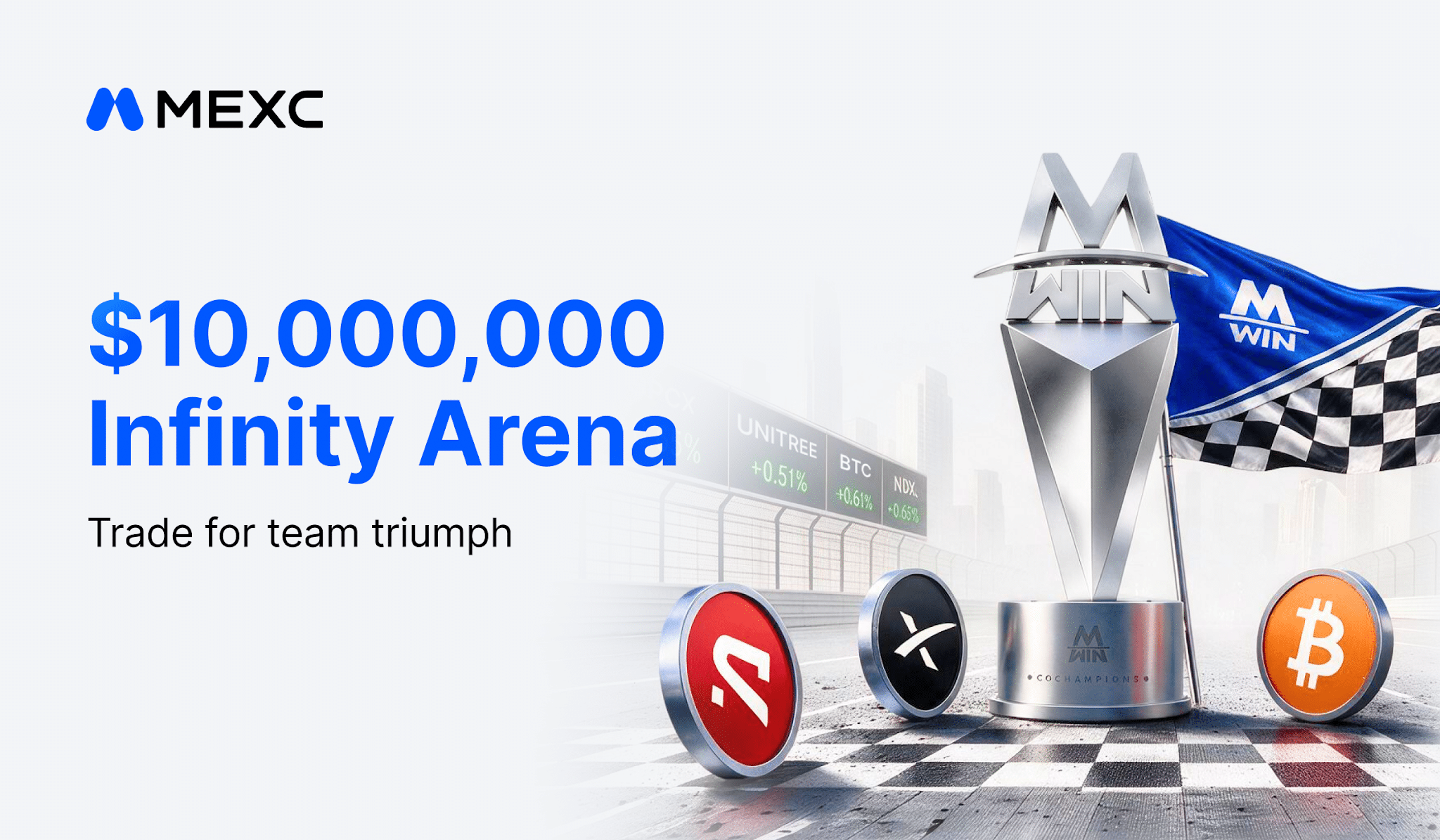
Mutsamudu, Comoros, August 19, 2026 – MEXC, a pioneer in 0-fee digital asset trading, announced the launch of "MEXC Win: Infinity Arena," a team-based futures trading competition. The competition offers 0-fee stock trading and a tiered prize pool of up to 10 million USDT. Early bird registration opens August 19 at 12:00 (UTC), with early participants eligible to share a 10,000 USDT futures bonus pool and additional rewards for early team formation.
Tue 18 Aug 2026 ▪
3 min read
Mutsamudu, Comoros, August 14, 2026 – MEXC, a pioneer in 0-fee digital asset trading, has released its August 2026 Proof of Reserves (PoR) report, audited by Hacken, showing that reserve ratios for all major assets remained above 100%, with the BTC reserve ratio reaching 288%. This report reflects MEXC's robust financial position and its continued commitment to safeguarding user assets.

Sun 09 Aug 2026 ▪
3 min read
Mutsamudu, Comoros, August 3, 2026 – MEXC, a pioneer in 0-fee digital asset trading, has launched the Earnings Season RealStocks Rally. The event runs from August 3, 2026, 10:00 (UTC) to August 24, 2026, 10:00 (UTC). Earnings season brings renewed attention to U.S. equities, as companies…

Tue 13 Oct 2026 ▪
5 min read
▪
by
Bitcoin operates in a crypto market that has become more cautious again: CoinMarketCap's sentiment index drops to 56 out of 100 on October 13, 2026, compared to 57 for Alternative.me. Cointribune compares the two indicators and the flows of Bitcoin ETFs.

Tue 13 Oct 2026 ▪
5 min read
▪
by
Meta returns to the race for the most powerful AI models with Muse Wonder and Muse Wonder Full. Launched on October 12, the two models feature a context window of one million tokens. On several benchmarks published by Meta, Wonder Full outperforms GPT-6 Astra and Claude Opus 5.5. Independent tests are more nuanced: Anthropic remains ahead in the overall ranking.

Tue 13 Oct 2026 ▪
4 min read
▪
by
The founder of Avalanche believes that the crypto industry is too focused on a potential break of cryptography. According to him, artificial intelligence could first exploit the vulnerabilities already present in software and wallets.

Tue 13 Oct 2026 ▪
5 min read
▪
by
Bitcoin fell below 82000 dollars on October 12th, triggering a cascade of liquidations across the crypto market. Contrary to what the headline figure might suggest, the 406 million dollars do not only concern BTC, but all long positions recorded over 24 hours.

Tue 13 Oct 2026 ▪
7 min read
▪
by
BitMine purchased 12,532 ETH in the week ending October 11, 2026. Despite this Ethereum accumulation, the total value of its crypto assets, cash, and holdings decreased from $17.4 billion to $16.2 billion in one week.

Mon 12 Oct 2026 ▪
6 min read
▪
by
Bitcoin mining companies are looking to convert their power sites into data centers for artificial intelligence. This transformation would require nearly 50 billion dollars in the short term, while lenders impose increasingly variable financing conditions.

Mon 12 Oct 2026 ▪
7 min read
▪
by
Cyfrin classified hidden fields in 1inch clear signing descriptors as high severity. The rules still apply to 13 networks, including Ethereum.

Mon 12 Oct 2026 ▪
5 min read
▪
by
The US dollar is returning to levels it hasn't seen in 18 months. The DXY hovers around 102.2 after starting from about 98.8 in early September. For crypto, the timing is bad: the United States will release their September CPI on October 14, just two weeks before the Fed's next decision. Bitcoin had resisted the dollar's rise in September. It must now do so again.

Mon 12 Oct 2026 ▪
5 min read
▪
by
Despite the recent correction of bitcoin, several technical and on-chain indicators signal a possible return of the bull market. BloFin Research even estimates that BTC has entered a new cycle, but this hypothesis still depends on maintaining several key supports.

Mon 12 Oct 2026 ▪
8 min read
▪
by
China wants to build a national blockchain network. In a strategic document published on October 9, 2026, the Central Committee of the Chinese Communist Party and the State Council list this infrastructure among the priorities of economic modernization. The goal is to better connect businesses, IT systems, and data nationwide.

Mon 12 Oct 2026 ▪
10 min read
▪
by
Bitcoin tries to extend its rebound towards 84,000 dollars, but buyers still struggle to impose their pace. On October 11, 2026, its price hovers around 83,770 dollars after hitting a recent low of 80,308 dollars. This rise improves technical conditions without confirming a sustainable return of the uptrend. Between persistent resistances, mixed moving averages, and hesitant indicators, the market is still seeking a clear signal.

Mon 12 Oct 2026 ▪
5 min read
▪
by
Donald Trump announced on October 11 an immediate "energy truce" between Russia and Ukraine. But Kiev claims it was not informed of a final agreement, Moscow has not confirmed it, and Russian strikes on Ukrainian facilities continued after the American statement.
Mon 12 Oct 2026 ▪
4 min read
▪
by
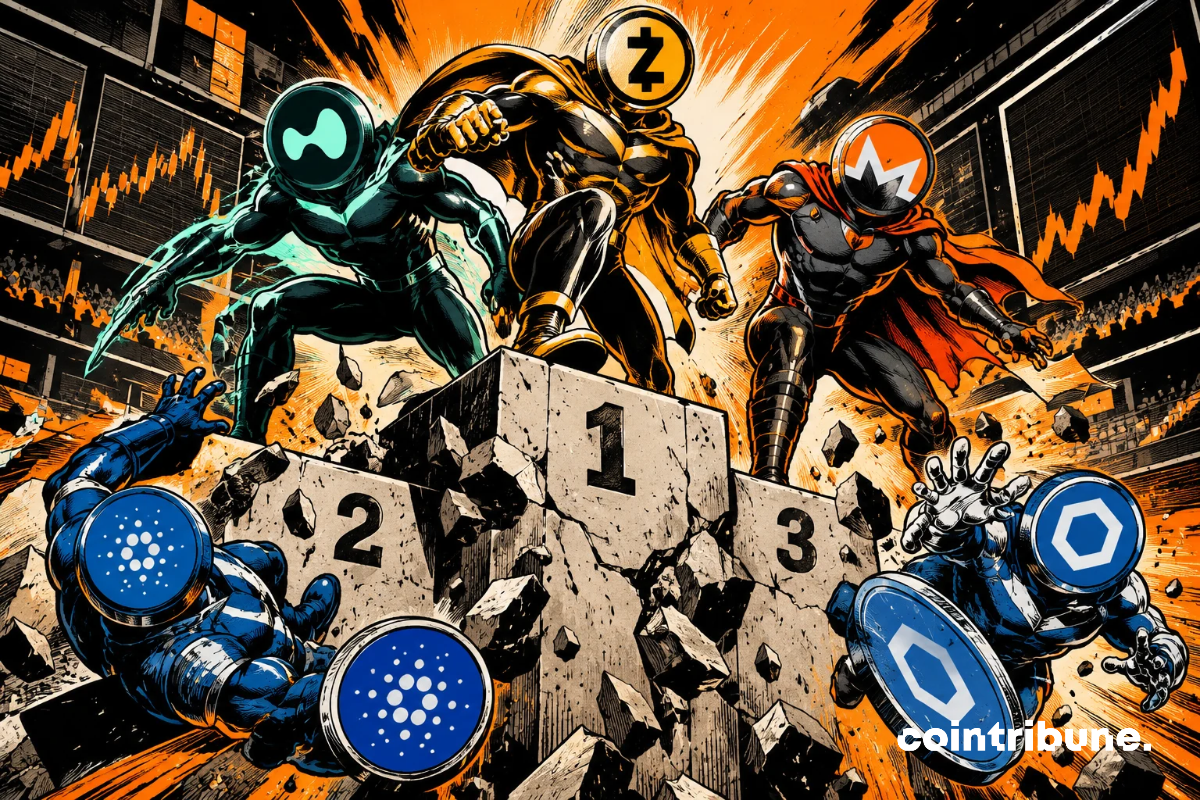
The ranking of the top ten largest cryptos, excluding stablecoins, is evolving. Zcash, Monero and Hyperliquid are now entering the list, while Cardano and Chainlink are falling back. This reshuffle reflects a capital rotation towards more volatile assets, as several major cryptos go through a difficult period.

Sun 11 Oct 2026 ▪
6 min read
▪
by
The company Strategy may soon strengthen its bitcoin reserves, after a new message from Michael Saylor published on October 11. The leader shared an orange chart that renews speculation about an upcoming acquisition. This publication comes a few days after a purchase of 334 BTC, valued at $28.7 million. However, the company's cash reserves must also cover its financial obligations, including dividends and debt interest.

Sun 11 Oct 2026 ▪
5 min read
▪
by
Elon Musk claims to see a trajectory that would allow SpaceX to be worth several times the current global economy. The entrepreneur himself acknowledges the highly speculative nature of this hypothesis, greeted with optimism by Michael Saylor.

Sun 11 Oct 2026 ▪
6 min read
▪
by
Arthur Hayes remains very bullish on crypto. The co-founder of BitMEX believes that current concerns around artificial intelligence and cryptographic security will not be enough to prevent a new major cycle. His scenario is mainly based on one element he has been tracking for years: liquidity. If governments start massively creating money again to support the economy, Bitcoin and other crypto assets could benefit.

Sun 11 Oct 2026 ▪
4 min read
▪
by
▪
Partnership
Cointribune launches a new Read2Earn quest in partnership with OKX, a centralized cryptocurrency exchange. On the agenda: a series of articles to discover the platform, understand its specifics, and explore the services it offers. But this new adventure also holds a surprise for readers: a 13-inch MacBook Air is up for grabs!

Sun 11 Oct 2026 ▪
5 min read
▪
by
The Ledger case takes a new turn. The crypto wallet manufacturer confirms having discovered an unauthorized hardware implant in the device of a user affected by recent thefts in Southeast Asia. The theory of physical tampering before delivery is gaining strength. The suspected losses now approach 93 million dollars, but this amount has not been validated by Ledger.

Sun 11 Oct 2026 ▪
15 min read
▪
by
Every project claims to have "the strongest community in crypto." We set out to measure it. On September 28, 2026, we recorded for seven projects their social engagements over 24 hours (LunarCrush), the size and live presence of their Discord and Telegram servers, their subreddits and, above all, what their members actually did this year: votes, fundraising, events, code. The result: XRP leads on volume, Chainlink and Cardano follow, Kaspa and Qubic are the most mobilized small caps, and Dogecoin, with the largest audience of the seven, is not the most active. Here is the ranking, its criteria and its limits.

Sun 11 Oct 2026 ▪
5 min read
▪
by
Adam Back claims to have warned Ethereum's early developers against an architecture he considered flawed. However, no easily verifiable public evidence establishes that he sent them a specific warning about the now criticized account model before the network's launch.

Sun 11 Oct 2026 ▪
5 min read
▪
by
Taking a photo of your bank card to let an AI do your shopping? That's Elon Musk's crazy suggestion on X. Between the panic of security experts and a wave of hilarious memes, the web is completely amazed. Pure madness or misunderstood genius this Musk?

Sun 11 Oct 2026 ▪
5 min read
▪
by
Between October 5 and 8, the cryptocurrency market experienced a marked correction, causing bitcoin to fall by 7.59%. After hitting a low of 80,393 dollars, the price rebounded to around 82,800 dollars. Despite this recovery, several indicators urge investors to be cautious. Market tensions and flows to exchange platforms maintain uncertainties, while the overall trend remains upward.

Sun 11 Oct 2026 ▪
6 min read
▪
by
Bitcoin could one day equal the gold capitalization, estimated around 30 000 billion dollars, according to Matt Hougan, Chief Investment Officer of Bitwise. This scenario would imply a price close to 1.5 million dollars per BTC, but is based on a historical comparison and not on a short-term forecast.

Sun 11 Oct 2026 ▪
4 min read
▪
by
Spot ETFs backed by ether recorded $542.1 million in net outflows last week. This is their worst weekly performance since January. The trend is also continuing on Solana, whose ETFs have just ended fourteen consecutive weeks of net inflows.

Sun 11 Oct 2026 ▪
4 min read
▪
by
Strive's SATA program reportedly generated about 55 million dollars this week, enough to buy nearly 638 bitcoins. But this financing capacity depends directly on the preferred stock price. From Wednesday, the stock fell below 100 dollars, preventing the company from continuing its issuances. A limit that recalls the risks of the Strategy-inspired model.
The leader in blockchain news, CoinTribune is an independent media outlet, not linked to any blockchain or crypto asset based project or advising, audit, fund management entity. We strive for the highest objective journalistic standards in French, English and Spanish focusing on alternative investments such as blockchain projects and crypto assets.
Request my coaching
Recherche
Subscribe to newsletter
Contact us