Trade Gold & Silver 24/7 on StandX: Perpetuals Now Live With Built-In Yield on Margin
Gold and silver have long been core pillars of global finance, offering reliable tools for hedging risk and diversifying portfolios. However, traditional market infrastructure has historically limited access through fixed trading hours and rigid settlement systems. In contrast, crypto markets introduced continuous liquidity, fast execution, and global accessibility. As a result, traders increasingly seek unified environments to access both asset classes. To address this shift, StandX integrates precious metals into its perpetual trading solutions, allowing users to trade gold and silver 24/7 with built-in yield on margin, reinforcing a more efficient and modern trading experience.
Why Gold and Silver Still Matter in Financial Markets
Precious metals continue to play a central role in global financial markets. Despite the rise of digital assets and new financial instruments, gold and silver remain widely monitored by investors seeking to understand broader economic trends and market sentiment. Their historical importance and ability to respond to macroeconomic shifts explain why these assets still attract strong trading interest today.
Gold and Silver as Safe-Haven Assets
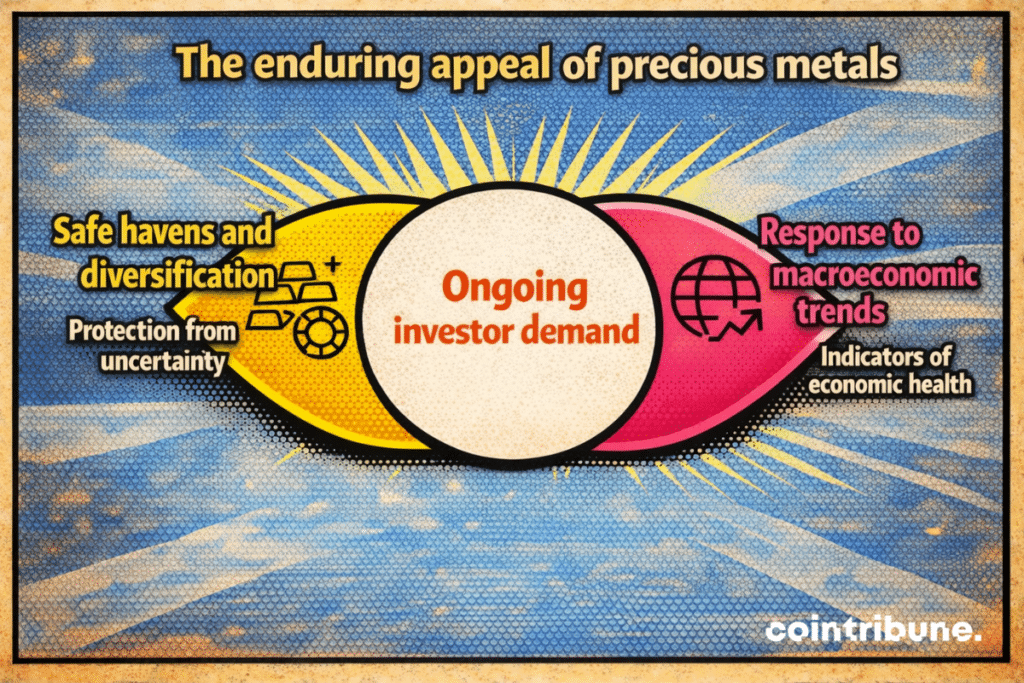
Gold and silver remain two of the most widely followed assets in global markets. Investors often monitor the gold and silver prices to understand broader economic trends.
Historically, precious metals have played several roles in financial markets. First, they are often considered safe-haven assets during periods of uncertainty. Second, they provide diversification when equity markets become volatile.
Market Participation and Investor Demand
Moreover, gold and silver markets attract both institutional investors and retail traders. Market participants frequently buy or sell gold exposure, depending on macroeconomic conditions.
For example, rising inflation or geopolitical uncertainty often increases demand for precious metals. As a result, trading activity around metals tends to increase during periods of financial instability.
Limitations of Traditional Metals Trading Hours
However, traditional metals markets still operate within defined trading hours. This limitation can restrict traders who wish to react quickly to global market events, particularly when significant news breaks outside of these hours, leading to potential missed opportunities for profit or risk management.
Therefore, crypto-based trading platforms are increasingly exploring ways to offer continuous access to precious metals markets.
How Crypto Trading Is Changing Access to Precious Metals
The rapid expansion of cryptocurrency markets has introduced new ways for traders to access financial assets. By leveraging blockchain-based trading infrastructure, crypto platforms are redefining how market participants interact with traditional assets such as gold and silver.
Continuous Trading Without Market Closing Hours
Crypto trading platforms have introduced a new model for accessing financial assets. Unlike traditional exchanges, crypto markets operate continuously without closing hours.
As a result, traders can react to market news at any time of day. This flexibility significantly changes the trading experience for many market participants.
Gaining Exposure Through Derivatives
In addition, crypto derivatives platforms allow traders to gain exposure to assets without holding them physically. This model simplifies access to markets such as gold and silver.
In the crypto ecosystem, gold and silver trading generally refers to derivative instruments that track the market price of these precious metals on blockchain-based platforms. Instead of purchasing physical bullion, traders gain exposure to price movements through digital trading contracts.
For instance, a trader may open a position on gold price movements without purchasing physical bullion, which refers to the actual gold bars or coins. Similarly, he can sell silver exposure through derivative contracts.
Why Crypto Platforms Attract Metals Traders
Several advantages explain why crypto platforms are attracting metals traders:
- Continuous trading availability.
- Fast execution through digital infrastructure.
- Easier access for global market participants.
As a result, the distinction between traditional financial markets and decentralized finance is becoming increasingly hazy, accompanied by a steady rise in trading activity across decentralized platforms. Such environments that combine crypto infrastructure with traditional assets may therefore attract a growing number of traders.
As Perp DEXs continue to expand their market coverage, several protocols are beginning to integrate commodities directly into their trading environments. StandX recently launched perpetual markets for two major precious metals.
StandX Launches Gold and Silver Perpetual Contracts
StandX has recently launched perpetual markets for two major precious metals, offering direct on-chain exposure to gold and silver.
The protocol now features:
- Gold perpetual contracts based on $XAU price.
- Silver perpetual contracts based on $XAG price.
Users can maintain their positions indefinitely, provided they meet the margin requirements, as these contracts have no expiration. Furthermore, these derivatives offer access to leverage, which helps traders execute more capital-efficient strategies compared to standard spot trading. Ultimately, this functionality provides the flexibility needed to hedge risk or optimize market positioning.
This expansion highlights the ecosystem’s momentum; the platform recently reached a top 10 position among global Perp DEXs with only two trading pairs. Consequently, this addition broadens the protocol’s scope beyond crypto-native assets, allowing traders to diversify into metals while remaining within a unified decentralized environment.
Yield-Bearing Margin for Gold and Silver Trading
StandX integrates yield generation directly into its trading infrastructure. Unlike derivative platforms where collateral remains idle, this protocol enables traders to maintain market exposure to gold (XAU) and silver (XAG) while simultaneously earning yield on their margin.
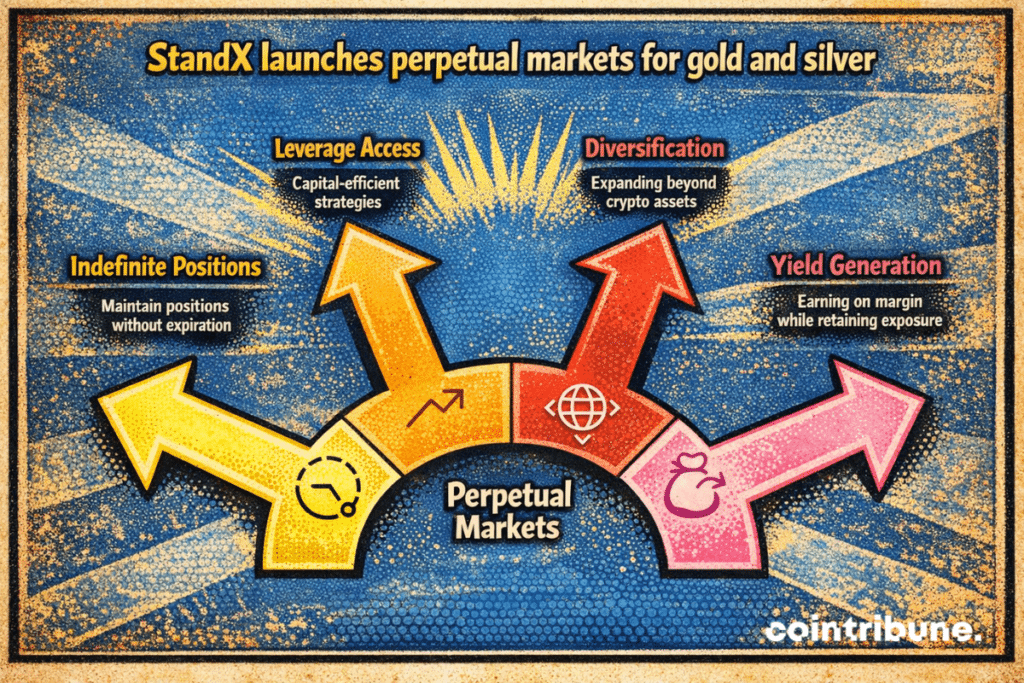
Trading pairs use $DUSD as the main collateral, which automatically earns returns on margin balances without needing users to manually stake or lock up their funds. Consequently, traders capture upside from precious metals price movements while their margin capital remains productive. This design helps traders pursue dual financial objectives: market speculation and passive income within a single, unified environment.
Leverage, Margin Tiers and Trading Parameters
The system supports high-precision trading for both XAU-USD and XAG-USD pairs. Users can execute positions with a minimum order size of around 0.001 units and access leveraged exposure up to approximately 40x. Price discovery operates with fine increments—typically around 0.1 for gold and 0.01 for silver—helping traders manage entry and exit levels with greater precision.
To support capital efficiency while managing systemic risk, StandX’s ecosystem uses a tiered margin framework in which leverage and maintenance requirements adjust according to the notional size of a position. In general, smaller positions may access higher leverage, while larger positions are subject to progressively stricter margin requirements. As position sizes increase, the maximum leverage decreases; these requirements become more stringent.
This structure designed by StandX’s team aims to balance flexibility for traders with risk management mechanisms intended to support the overall stability of the protocol.
What the Expansion of StandX Means for Precious Metals Traders
The expansion of StandX toward precious metals derivatives signals a structural evolution in how decentralized trading venues develop their market scope. By adding tools connected to gold and silver prices, the protocol expands the variety of external price references used in its trading system, contributing to broader crypto market liquidity, supported by one of the deepest BTC orderbook in crypto.
For many market participants, observing the reaction of commodities and digital assets to the same macroeconomic events can provide additional context when evaluating positioning. Price activity in these assets often reflects signals emerging from traditional finance, including shifts in monetary policy expectations, currency dynamics, and broader capital allocation trends. Within the same derivatives infrastructure, this activity introduces additional layers of market data that traders can incorporate into their analysis.
Furthermore, the presence of commodities alongside crypto assets encourages participants to assess the way liquidity flows across different segments of the global financial system. Periods of stress, policy changes, or shifts in investor risk appetite often trigger cross-asset reactions simultaneously. Monitoring these interactions within a unified trading environment can help traders better understand how broader market narratives evolve.
More broadly, the integration of commodities into platforms such as StandX reflects how decentralized derivatives infrastructure continues to expand beyond purely crypto-native markets. As trading environments incorporate a wider set of financial instruments, Perp DEXs increasingly resemble multi-asset trading venues, reflecting global economic signals.
A New Stage for Decentralized Derivatives Markets
The expansion of StandX toward gold and silver perpetual markets reflects a broader shift in decentralized trading infrastructure. By introducing commodities alongside crypto assets, the protocol expands the range of market activity that traders can analyze within a single derivatives environment.
More broadly, this development illustrates how decentralized finance (DeFi) continues to evolve beyond purely crypto-native markets. As platforms incorporate additional financial instruments, decentralized trading environments increasingly reflect the diversity of global financial markets.
Ultimately, initiatives such as the integration of precious metals derivatives on StandX highlight the gradual emergence of more versatile DeFi trading ecosystems. Within these environments, traders navigate signals coming from multiple asset classes while interacting with features such as stablecoin APY from staking and funding arbitrage, which further illustrate how decentralized financial infrastructure continues to evolve.
Maximize your Cointribune experience with our "Read to Earn" program! For every article you read, earn points and access exclusive rewards. Sign up now and start earning benefits.

Journaliste et rédacteur web passionné par l’univers des cryptomonnaies et des technologies Web3. J’y traite les dernières tendances et actualités afin de proposer un contenu de haute qualité à un large public du secteur.
The contents and products mentioned on this page are in no way approved by Cointribune and should not be interpreted as falling under its responsibility.
Cointribune strives to communicate all useful information to readers, but cannot guarantee its accuracy and completeness. We invite readers to do their research before taking any action related to the company and to take full responsibility for their decisions. This article should not be considered as investment advice, an offer, or an invitation to purchase any products or services.
Investment in digital financial assets carries risks.
Read more